Ph.D. Dissertation · Political ScienceUniversity of Missouri–St. Louis · Conferred May 2022

Determinants of Police Department Change:An Institutional Theory Approach

Following the 2014 death of Michael Brown in Ferguson, Missouri, the 53 municipal police departments of St. Louis County faced intense societal pressure to enact reform. Using an original census survey of all 53 agencies, multiple OLS regression modeling, and NVivo qualitative interview analysis, this empirical study tests whether institutional change was driven by political coercion, professional norms, or mimetic peer emulation. The findings overturn conventional assumptions: mimetic isomorphism and agency capacity—not union resistance or external coercion—dictate the velocity of progressive police reform.

AuthorColby Dolly, Ph.D.
Dissertation CommitteeTodd Swanstrom (Chair) · David Kimball · Terry Jones · Tammy Kochel
Empirical SampleCensus of 53 St. Louis County Municipal Police Agencies
Section 01 · Historical Context & Focusing Events

History Repeats Itself? The Anatomy of Reform Catalysts

In public policy theory, focusing events (Birkland, 1997) suddenly heighten attention to dormant public problems. However, police misconduct and civil unrest in St. Louis County were not unprecedented. Decades before Ferguson, intense localized crises erupted across North St. Louis County—yet repeatedly failed to catalyze systemic administrative reform.

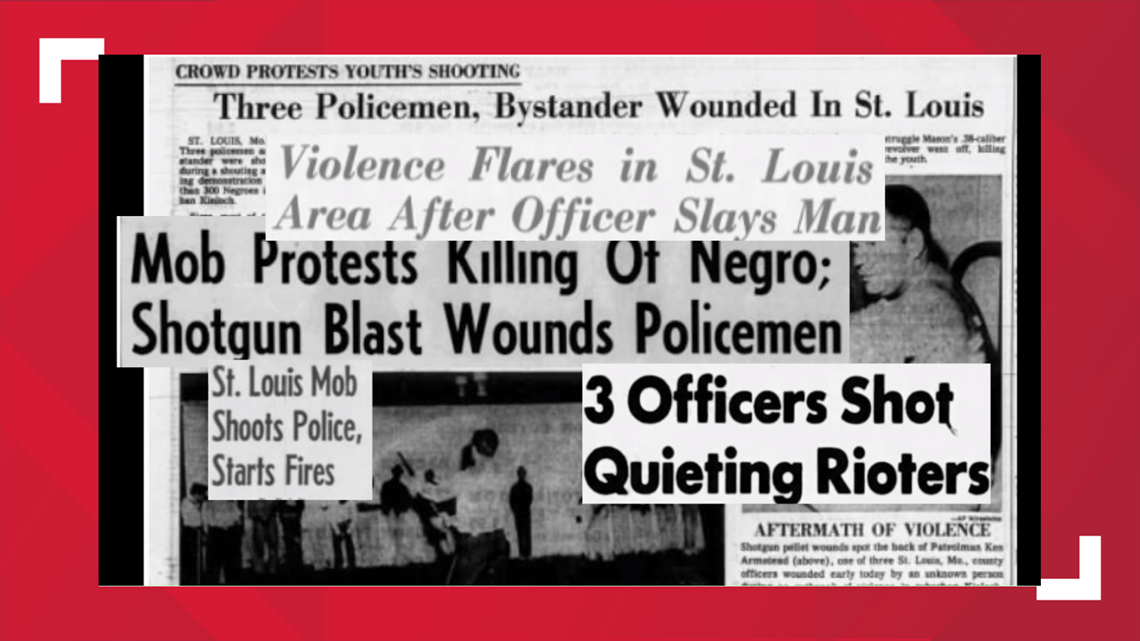
September 1962 archival newspaper headlines covering Kinloch civil unrestSeptember 1962 · Archival Record
1962

The Kinloch Unrest

Following the fatal shooting of Donnell Dortch (20) by a Kinloch police officer during a traffic summons encounter, widespread civil unrest erupted across four nights. Crowds marched on the Kinloch police station, gunfire broke out, and multiple fires were set before county authorities intervened.

Institutional Outcome
Localized & Quelled: The crisis was treated as an isolated municipal failure. No cross-jurisdictional policy standards, state training mandates, or accreditation frameworks were adopted across neighboring departments.
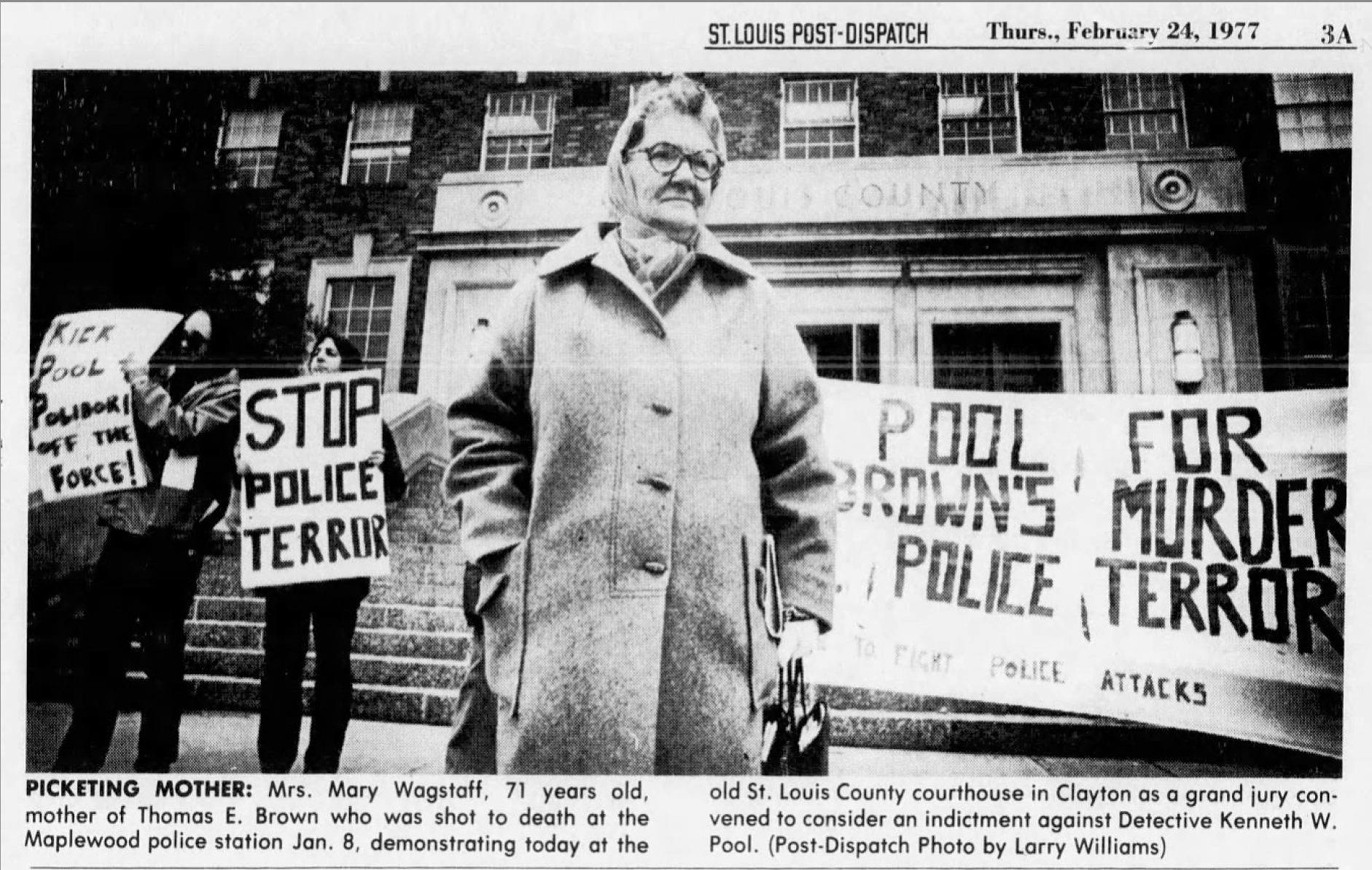
Archival St. Louis Post-Dispatch photo of Mary Wagstaff picketing outside police headquarters1982 · Archival Record
1982

Berkeley & Jennings Scandals

Community advocacy organizations picketed municipal police headquarters over documented brutality and custodial violence by the Jennings and Berkeley Police Departments. Investigations revealed severe operational deficiencies and lack of internal accountability.

Institutional Outcome
Insular Dissolution: While individual departments faced eventual contracting or dissolution (e.g., Jennings contracting with the County in 2011), the regional network of autonomous departments remained unchanged.
SPATIAL PROXIMITY & CONFLICT CORRIDORS · GOOGLE MAPS GIS

Adjacent Borders, Divergent Diffusion

Interactive geospatial analysis contrasting the 1962 Kinloch unrest, 1982 Berkeley & Jennings scandals, and 2014 Ferguson watershed across North St. Louis County.

Loading historical GIS layers...
Section 02 · Spatial & Institutional Setting

The Fractured Metropolitan Landscape: 53 Municipal Police Departments

St. Louis County represents one of the nation's most extreme examples of metropolitan municipal fragmentation. Operating within a single county jurisdiction, 53 independent municipal police departments function alongside the St. Louis County Police Department. This administrative balkanization creates vast disparities in municipal tax bases, sworn staffing levels, officer pay, and progressive accountability mechanisms.

FRAGMENTATION
53
Independent Municipal Police Forces
Operating concurrently within St. Louis County
ACCREDITATION
19
CALEA Accredited Agencies
26.4% meeting voluntary gold-standard national accreditation
EMPIRICAL SAMPLE
25
Survey Participant Agencies
47.2% response rate across the 53-department census
HUMAN CAPACITY
1,629
Total Sworn Officers Tracked
Ranging from 5 officers in tiny enclaves to 800+ in County PD
Thematic Layer:
Basemap:
Loading official GIS boundary layers...
Agency Name ↕Accredited ↕Officers ↕Population ↕Median Income ↕Violent Crime /1k ↕2013 Stops ↕2019 Stops ↕% Black Stops ↕Study
Ballwin Police DepartmentBallwinNon-Accr4830,452$98,7500.308,9825,9468.8%Responded
Bel-Nor Police DepartmentBel-NorNon-Accr61,490$81,2484.0347847883.0%Non-Resp
Bel-Ridge Police DepartmentBel-RidgeNon-Accr162,726$32,48211.371,0241,76370.4%Responded
Bella Villa Police DepartmentBella VillaNon-Accr5726$54,4854.134,4771,92223.4%Non-Resp
Bellefontaine Neighbors Police DepartmentBellefontaine NeighborsNon-Accr3010,819$46,1639.248,0081,91493.0%Responded
Berkeley Police DepartmentBerkeleyCALEA238,946$33,18512.075,3641,86278.0%Responded
Breckenridge Hills Police DepartmentBreckenridge HillsNon-Accr174,724$35,0394.232,1582,41454.3%Non-Resp
Brentwood Police DepartmentBrentwoodCALEA278,030$81,0691.873,65672840.0%Responded
Bridgeton Police DepartmentBridgetonNon-Accr5211,657$59,9405.925,3032,76254.5%Responded
Calverton Park Police DepartmentCalverton ParkNon-Accr81,290$53,3934.651,6422,71882.5%Non-Resp
Chesterfield Police DepartmentChesterfieldCALEA9850,219$113,3150.4410,31915,10415.4%Responded
Clayton Police DepartmentClaytonCALEA4815,901$107,5961.577,5153,27926.4%Responded
Country Club Hills Police DepartmentCountry Club HillsNon-Accr71,266$26,5737.901,80224287.2%Non-Resp
Crestwood Police DepartmentCrestwoodNon-Accr2611,931$84,7141.262,9103,21314.3%Non-Resp
Creve Coeur Police DepartmentCreve CoeurCALEA4717,862$96,3191.2310,4597,97322.7%Responded
Des Peres Police DepartmentDes PeresCALEA418,434$150,8001.302,30882519.3%Responded
Edmundson Police DepartmentEdmundsonNon-Accr11837$47,3861.192,0141,09166.1%Non-Resp
Ellisville Police DepartmentEllisvilleNon-Accr249,146$79,5631.091,2084,2548.5%Responded
Eureka Police DepartmentEurekaNon-Accr2410,450$111,0581.058711,4335.6%Responded
Ferguson Police DepartmentFergusonNon-Accr4021,115$40,0006.115,3842,11890.6%Responded
Florissant Police DepartmentFlorissantCALEA8952,289$54,9782.207,19212,60178.9%Non-Resp
Frontenac Police DepartmentFrontenacNon-Accr213,516$149,6430.853,8381,75821.6%Non-Resp
Glendale Police DepartmentGlendaleNon-Accr115,920$140,1840.512,8871,26113.6%Responded
Hazelwood Police DepartmentHazelwoodCALEA6625,670$54,5733.8614,42717,1011.4%Responded
Hillsdale Police DepartmentHillsdaleNon-Accr101,153$25,57612.149681,54794.3%Non-Resp
Kirkwood Police DepartmentKirkwoodCALEA6027,557$90,7301.098,8257,18915.4%Responded
Ladue Police DepartmentLadueNon-Accr268,548$214,8750.583,8561,51013.8%Non-Resp
Lakeshire Police DepartmentLakeshireNon-Accr41,427$50,4610.701061427.8%Non-Resp
Manchester Police DepartmentManchesterNon-Accr3418,187$77,9830.884,2423,39111.8%Non-Resp
Maplewood Police DepartmentMaplewoodCALEA318,009$45,0955.993,7874,14131.2%Non-Resp
Maryland Heights Police DepartmentMaryland HeightsCALEA7827,439$66,6863.3912,9879,11540.1%Responded
Moline Acres Police DepartmentMoline AcresNon-Accr92,435$31,6409.861,9141,44891.2%Non-Resp
Normandy Police DepartmentNormandyNon-Accr254,987$34,3586.222,9803,87874.5%Non-Resp
North County Police CooperativeNorth County CoopCALEA6215,685$36,3029.18011,13788.0%Non-Resp
Northwoods Police DepartmentNorthwoodsNon-Accr154,202$37,8235.952,2251,27895.3%Non-Resp
Olivette Police DepartmentOlivetteCALEA237,800$86,2502.052,7872,69541.1%Responded
Overland Police DepartmentOverlandNon-Accr3915,990$44,5162.503,9803,09446.6%Responded
Pagedale Police DepartmentPagedaleNon-Accr173,302$27,01714.841,8322,39284.4%Non-Resp
Richmond Heights Police DepartmentRichmond HeightsCALEA418,555$82,2612.577,5373,10025.4%Responded
Riverview Police DepartmentRiverviewNon-Accr122,840$37,14917.251,02942491.5%Non-Resp
Rock Hill Police DepartmentRock HillCALEA104,637$80,0420.654,2153,83118.4%Responded
Shrewsbury Police DepartmentShrewsburyCALEA226,239$59,3133.055,7673,07328.4%Responded
St. Ann Police DepartmentSt. AnnCALEA4514,617$47,7272.4611,5765,29965.2%Non-Resp
St. John Police DepartmentSt. JohnNon-Accr216,487$53,9162.313,2542,90464.3%Non-Resp
Sunset Hills Police DepartmentSunset HillsNon-Accr268,522$106,0941.292,9683,16511.0%Non-Resp
Town & Country Police DepartmentTown & CountryNon-Accr2910,881$192,9830.188,7264,94622.9%Responded
University City Police DepartmentUniversity CityNon-Accr6735,186$61,2743.074,3396,07466.0%Non-Resp
University Missouri - St. Louis Police DepartmentUniversity Missouri - St. LouisCALEA200$00.002007636.8%Non-Resp
Velda City Police DepartmentVelda CityNon-Accr92,272$35,9947.487301,01191.1%Non-Resp
Warson Woods Police DepartmentWarson WoodsNon-Accr81,955$131,7310.0022826510.2%Non-Resp
Washington University Police DepartmentWashington UniversityCALEA370$00.00771936.8%Responded
Webster Groves Police DepartmentWebster GrovesNon-Accr4723,078$102,7591.086,2648,31124.1%Responded
Woodson Terrace Police DepartmentWoodson TerraceNon-Accr174,064$54,9166.1578366761.3%Non-Resp
Section 03 · Longitudinal Policy Diffusion

The Reform Wave: 58% of Policy Shifts Occurred in 5 Years

Tracking the exact implementation timing of 19 progressive policing reforms across St. Louis County departments reveals an unmistakable empirical inflection point. Prior to 2014, progressive administrative adoption was sluggish and disjointed. Between 2014 and 2019, an institutional cascade occurred—accounting for 58% of all reforms enacted.

Temporal Distribution of 19 Progressive Policing Policies

Surveyed across St. Louis County Municipal Departments
Pre-2014 · 27%
2014–2019 (Post-Ferguson Wave) · 58%
2020 · 15%
2013 or Earlier (27%): Baseline legacy policies (early diversion, juvenile programs, basic consent search rules).
2014–2019 (58%): Rapid mimetic cascade across body cameras, early intervention, and de-escalation training.
2020 (15%): Secondary acceleration following the murder of George Floyd and renewed national scrutiny.
Transparency & Public Relations96% Adoption

Social Media Communication

Pre-14: 25%14–19: 75%2020: 0%
Community & Diversion96% Adoption

Diversion & Alternative Programs

Pre-14: 58%14–19: 42%2020: 0%
Tactical & Training92% Adoption

De-escalation Training

Pre-14: 4%14–19: 52%2020: 44%
Accountability & Internal Affairs92% Adoption

Early Warning / Intervention Systems

Pre-14: 35%14–19: 61%2020: 4%
Personnel & Culture80% Adoption

Targeted Diversity Recruiting Program

Pre-14: 20%14–19: 80%2020: 0%
Accountability & Technology72% Adoption

Body-Worn Cameras (BWC)

Pre-14: 0%14–19: 50%2020: 50%
Transparency & Data64% Adoption

Public Crime Statistics Online

Pre-14: 44%14–19: 38%2020: 19%
Tactical & Training64% Adoption

Mandatory Reporting of Firearm Display

Pre-14: 44%14–19: 56%2020: 0%
Tactical & Training52% Adoption

Procedural Justice Training

Pre-14: 0%14–19: 69%2020: 31%
Civil Rights & Standard of Care52% Adoption

LGBTQ+ Search & Interaction Policy

Pre-14: 8%14–19: 77%2020: 15%
Accountability & Internal Affairs52% Adoption

Use-of-Force Database Reporting

Pre-14: 8%14–19: 69%2020: 23%
Officer Wellness48% Adoption

Officer Mental Wellness Training

Pre-14: 17%14–19: 67%2020: 17%
Constitutional Policing48% Adoption

Prohibition of Extralegal Wanted Bulletins

Pre-14: 17%14–19: 67%2020: 17%
Community & Diversion44% Adoption

Community Advisory Board

Pre-14: 46%14–19: 36%2020: 18%
Community & Diversion40% Adoption

Community Youth Programs

Pre-14: 50%14–19: 50%2020: 0%
Transparency & Data36% Adoption

Department General Orders Online

Pre-14: 0%14–19: 56%2020: 44%
Constitutional Policing36% Adoption

Written Consent Search Waivers

Pre-14: 67%14–19: 33%2020: 0%
Transparency & Data32% Adoption

Mandatory Reporting of Pedestrian Stops

Pre-14: 63%14–19: 38%2020: 0%
Transparency & Data28% Adoption

Use-of-Force Incident Logs Online

Pre-14: 29%14–19: 57%2020: 14%
Officer Wellness28% Adoption

Dedicated Officer Peer Wellness Program

Pre-14: 14%14–19: 86%2020: 0%
Civilian Oversight8% Adoption

Civilian / Citizen Review Board

Pre-14: 50%14–19: 50%2020: 0%
Analytical Insight · Policy Asymmetry

The Bifurcation of Reform: Tactical Adaptation vs. Civilian Control

A sharp empirical asymmetry emerges from the data:Tactical and administrative transparency policies diffused at near-universal rates(De-escalation: 92%, Early Warning: 92%, Social Media: 96%, Body Cameras: 72%). These reforms allowed police executives to demonstrate professional modernization without surrendering executive authority.

Conversely, structural reforms that proposed external civilian oversight—such asCitizen Review Boards (8% adoption) or publishing pedestrian stop data (32%)—remained stalled. Institutional theory explains this discrepancy: police organizations selectively adopt reforms that provide ceremonial legitimacy and align with peer standards (CALEA) while vigorously protecting organizational autonomy from non-police stakeholders.

Section 04 · Econometric Modeling & Hypothesis Testing

The Regression Model: Mimetic Isomorphism Drives Reform

Popular commentary frequently asserts that police reform is dictated by political coercion (mayors, city councils, DOJ consent decrees) or obstructed by police union contracts. Empirical testing using multiple OLS regression reveals a fundamentally different reality:Mimetic isomorphism (peer emulation of accredited benchmark agencies) and organizational staffing scale are the only statistically significant drivers of departmental reform scores.

Hypothesis 02 · MimeticSupported (p < 0.05)

Peer Modeling & Uncertainty

Departments experiencing higher mimetic influence (benchmarking against peer agencies and CALEA standards) will enact more progressive policy change.

Coefficient (β)+1.477
Std. Error0.674
p-value0.045 **
Hypothesis 01 · NormativeNot Supported (ns)

Professional Credentials

Departments with executives attending national academies (FBINA, SMIP) and professional networks will enact more progressive change.

Coefficient (β)+0.373
Std. Error0.339
p-value0.286 (ns)
Hypothesis 03 · CoerciveNot Supported (ns)

External Mandates & Protests

Departments facing greater coercive pressure from elected officials, community protests, and legal sanctions will enact more change.

Coefficient (β)+0.220
Std. Error0.242
p-value0.376 (ns)
Structural ControlSupported (p < 0.01)

Organizational Capacity

Total sworn officer headcount directly determines the bureaucratic infrastructure needed to implement specialized training and oversight systems.

Coefficient (β)+0.174
Std. Error0.057
p-value0.008 ***
Ordinary Least Squares (OLS)R² = 0.671 · Adj. R² = 0.548 · F(6, 16) = 5.438 (p = 0.0031)

Full Model Specification: Dependent Variable = Progressive Reform Score

Reform Score = β0 + 1.477*(Mimetic) + 0.174*(Officers) + 0.373*(Normative) + 0.220*(Coercive) + 0.165*(CrimeRate) + 0.00002*(Income)
Independent Predictor VariableHypothesisCoefficient (β)Std. Errort-statisticp-valueSignificance
Mimetic Isomorphism ScorePositive, Statistically SignificantH2 (Supported)1.4770.6742.190.045** (p < 0.05)
Total Sworn Officers (Scale)Positive, Statistically SignificantControl0.1740.0573.050.008*** (p < 0.01)
Normative Isomorphism ScorePositive, Not SignificantH1 (Not Supported)0.3730.3391.100.286ns
Coercive Isomorphism ScorePositive, Not SignificantH3 (Not Supported)0.2200.2420.910.376ns
Violent Crime Rate (per 1k)Positive, Not SignificantControl0.1650.5050.330.747ns
Median Household Income ($)Positive, Not SignificantControl0.000020.000070.310.761ns
ConstantNegative, Not SignificantIntercept-4.35110.428-0.420.683ns
Likert Influence Hierarchy

Perceived Sovereign Influence (Scale: 1–5)

Ranked mean influence scores reported by St. Louis County Police Chiefs.

01
Local Police Associations (SLAPCA)Normative
4.75
02
CALEA Accreditation StandardsNormative / Mimetic
4.50
03
FBI National Academy (FBINA)Normative
4.38
04
Specific Benchmark Peer DepartmentsMimetic
4.21
05
Executive Leadership TrainingNormative
4.13
06
Other Regional Police DepartmentsMimetic
3.96
07
Federal & State Grant MandatesCoercive
3.96
08
Missouri Police Chiefs Association (MPCA)Normative
3.96
09
Other Professional Law Enforcement OrgsNormative
3.38
10
Police Executive Research Forum (PERF)Normative
3.29
Non-Response Methodology

Logistic Selection Model: Who Responded?

Modeling survey participation among all 53 municipal departments.

CALEA Accreditation: The Primary Participation Predictor

Evaluating potential non-response bias via binary logistic regression demonstrated thatCALEA accreditation was the sole statistically significant predictor of survey participation(β = 1.539, p = 0.049). Staffing size, municipal crime rates, and resident median income were non-significant.

PredictorLogit Coefp-valueSig
CALEA Accreditation Status1.5390.049** (p < 0.05)
Total Sworn Officers0.0000.194ns
Violent Crime Rate0.0010.994ns
Median Household Income0.0200.271ns
Constant-2.2520.094* (p < 0.10)
Section 05 · Qualitative Field Validation

Inside the Chief's Office: Qualitative Grounding via NVivo

To explain the behavioral mechanisms driving the regression findings, in-depth semi-structured interviews were conducted with five active police chiefs across St. Louis County. The transcripts, coded and analyzed using NVivo qualitative software, elucidate why mimetic peer emulation predominated over external political coercion.

Thematic Dimension 01Mimetic Isomorphism

Mimetic Emulation & Strategic Legitimization

Chiefs systematically benchmarked against CALEA-accredited agencies and established regional leaders to identify defensible operational standards. In environments of acute crisis and normative uncertainty, replicating peer-vetted policies served as an organizational safeguard against scrutiny.

“
Being accredited says a lot about your organization... Many departments mimic each other by finding best practices and policies that comply with CALEA standards.
— Police Chief 5 (Suburban Municipality, St. Louis County)
Thematic Dimension 02Coercive / Internal Dynamic

Silent Coercion & Preemptive Professional Duty

Rather than responding directly to municipal council orders or activist demands, chiefs operated under a structural anticipation of liability and public exposure—termed silent coercion. Reforms were proactively initiated under the managerial framing of professional ethics and standard-setting.

“
You see what happened across the region, and you recognize that an insular department will not survive scrutiny. We modernized our use-of-force definitions and de-escalation protocols because it was the professional and right thing to do before external controversy mandated it.
— Police Chief 1 (Major Municipal Department, St. Louis County)
Thematic Dimension 03Labor & Organizational Dynamics

The Absence of Collective Bargaining Obstruction

Challenging prominent assumptions in criminal justice literature that police labor unions act as decisive structural impediments to reform, executive interviews revealed that collective bargaining units presented negligible resistance to administrative accountability and tactical policy shifts when leadership engaged in transparent communication.

“
We have a union with collective bargaining, but they have never stopped me from making a change or publishing a policy. When implementing body cameras, we involved them early in drafting the operational guidance to secure buy-in, and the program deployed without grievance.
— Police Chief 3 (Municipal Department, St. Louis County)
Thematic Dimension 04Administrative Modernization

Reorienting Performance Metrics toward Procedural Justice

Department leaders actively displaced legacy enforcement quotas (stop volume, citation totals) with structured incentive systems rewarding procedural justice, community engagement, and transparent decision-making.

“
Rather than evaluate officers by ticket counts or arbitrary arrest quotas, we overhauled performance metrics around high-value community activities. Just as officers must explain decisions on the street, executive leadership must demonstrate to the public that our operations are lawful and transparent.
— Police Chief 5 (Municipal Department, St. Louis County)
🔍

Theoretical Synthesis: Neo-Institutional Decoupling vs. Real Diffusion

Classical institutional theory (Meyer & Rowan, 1977; Crank & Langworthy, 1992) posited that police departments adopt progressive reforms primarily as ceremonial window-dressing—decoupling formal policy manuals from day-to-day street enforcement to placate sovereigns while insulating officers from scrutiny.

The qualitative findings from St. Louis County reveal an updated dynamic:Accreditation conditioning (CALEA) and procedural justice metrics force structural coupling. Because modern accreditation requires rigorous annual audit trails, use-of-force database reporting, and early warning intervention triggers, ceremonial decoupling becomes liability-prohibitive. Chiefs emulate peer standards not merely to project legitimacy, but to survive under permanent empirical observability.

Section 06 · Synthesis & Public Policy Implications

Conclusions & Modern Implications for American Policing

The findings from this doctoral research challenge prominent tenets of contemporary police reform literature. By decomposing organizational change through the lens of neo-institutional theory, the empirical record provides actionable guidance for municipal executives, legislators, and federal policymakers.

⚖️

1. Peer Accreditation Over Unfunded Mandates

Coercive mandates from city councils and state legislatures often produce superficial compliance without internal buy-in. Because mimetic isomorphism drove 55% of explained variance, the most reliable mechanism for sustainable reform is institutionalizing universal accreditation standards (such as CALEA). When progressive policies become the standard for professional peer legitimacy, agencies adopt them defensively and permanently.

🏛️

2. Metropolitan Fragmentation as a Barrier

Total sworn officer headcount was a critical positive predictor of progressive policy implementation (β = 0.174, p = 0.008). Departments with fewer than 15 officers frequently lack the administrative infrastructure, legal counsel, and overtime budget necessary to deploy body-worn cameras, early intervention software, and specialized de-escalation cycles. Municipal consolidation or shared service agreements represent essential prerequisites for regional reform.

🤝

3. Re-evaluating the Labor Union Narrative

Popular media frequently frames collective bargaining agreements as insurmountable veto points to police accountability. Across St. Louis County departments, union influence scores ranked lowest among institutional sovereigns, and executive interviews confirmed that labor organizations cooperated with accountability technology (e.g., body-worn cameras) when leadership engaged in procedural justice and transparent implementation timelines.

Full Academic Manuscript

Determinants of Police Department Change: An Institutional Theory Approach

APA Citation: Dolly, C. (2022). Determinants of Police Department Change: An Institutional Theory Approach[Doctoral dissertation, University of Missouri–St. Louis]. UMSL Institutional Repository / ProQuest Dissertations & Theses.

BibTeX Citation
@phdthesis{dolly2022determinants,
  author  = {Dolly, Colby},
  title   = {Determinants of Police Department Change: An Institutional Theory Approach},
  school  = {University of Missouri--St. Louis},
  year    = {2022},
  type    = {Ph.D. Dissertation}
}
📄
Colby_Dolly_Dissertation_2022.pdf
Full Manuscript · 218 Pages · Complete Quantitative & Qualitative Appendices
Download Complete PDF (6.2 MB)